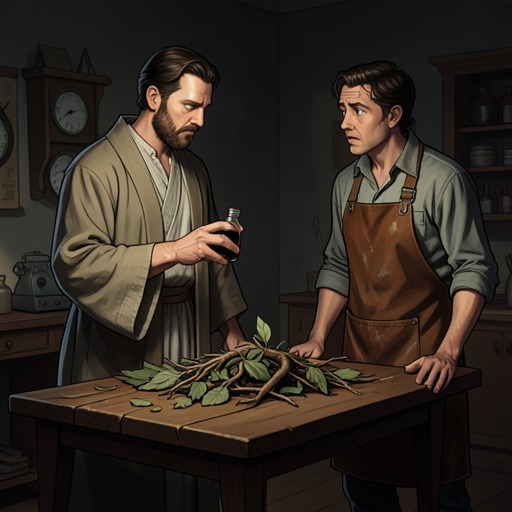
Kinma’s Horse-Burial Commandment
The Deer KingKinma’s Horse-Burial Commandment is a rule attributed to Kinma that distinguishes between horses that die in general and horses that die of sickness: the former should be burned, while the latter should be buried. Preserved as a sacred chant and described as a past Ahfal Oma practice, the commandment connects the handling of animal remains with wolves, horse-eating, and the breeding of hunting dogs. During an investigation into Mittsual, that inherited practice offers a possible route by which disease might have passed among animals—but the observed outcome complicates the explanation.
The Rule and Its Rationale
Cheehana introduces the commandment as an old story about the Ahfal Oma’s hunting dogs, the Rochai, a cross between black wolves and Ossam. She recalls Kinma’s instruction that a horse that dies should not be buried, lest wolves dig it up and acquire a taste for horseflesh; instead, it should be burned. A horse that dies of sickness, by contrast, should be buried so that a wolf that eats it will become ill and avoid horseflesh thereafter. The rule thus makes the manner of a horse’s death determine how its body is treated, with the intended consequence falling on wolves.
The chant does not present the rule merely as a disposal custom. It gives the burial of sick horses a second purpose: their remains become part of a story about the origin and character of the dogs. Its paired commands—burn the ordinarily dead horse, bury the sick one—set out distinct responses to distinct causes of death, while imagining the buried body as a means of changing animal behavior.
The Chant of Kinma and the Dogs
After Cheehana begins the tale, Shikan takes up the chant. In its story, during a harsh winter when both horses and people were starving, Kinma approaches a pregnant bitch whose pups have a wolf for a sire. Asked whether she will bear the pups despite the pain, the bitch answers that she will. Kinma leads her to a mound where sick horses have been buried. The bitch eats from the remains, falls ill, gives birth, and dies; her pups survive and grow into the village’s finest hounds.
Shikan’s account makes the mound both a place of burial and the setting for a consequential exchange between horse remains and a dog’s offspring. The chant attributes the pups’ survival and excellence to this encounter. Its religious framing presents a costly act by the mother and a lasting benefit in the next generation, while connecting the dogs’ celebrated qualities to the treatment of horses that died of illness.
Custom and the Mittsual Investigation
Shikan explains that the chant had a counterpart in Ahfal Oma practice. When fire horses were plentiful, those that died of illness were buried in a mound; later, their carcasses were dug up and fed to pregnant bitches. According to him, unlike the bitch in the ancient song, the dogs did not die, and their pups grew loyal and strong and did not succumb to sickness. Tomasolle adds a further instance: when horses died after eating poisoned rye, the Ahfal Oma also buried them in a mound and fed them to pregnant bitches.
The practice becomes relevant as the group considers how disease could have reached dogs and wolves across a wide area. In the same discussion, a possible explanation is raised: the pups might have become carriers of Mittsual. That would connect the horse-burial custom with the scattered animal attacks under investigation and offer a route for disease to enter canine populations. But the proposed link remains a hypothesis, not a conclusion established by the commandment or the chant.
The Complication and Significance
Tomasolle rejects the proposed explanation on the basis of what he says he personally confirmed. The bitches bore no pups; they suffered and died. This observation breaks the correspondence between the chant’s story, Shikan’s account of the dogs, and the outcome in the case being discussed. The burial and feeding practice is attested, but the particular explanation that infected pups carried the disease does not fit what happened to the pregnant dogs.
The commandment therefore functions at once as religious teaching, practical animal custom, and evidence in an inquiry whose answer is still uncertain. Its rule assumes that the treatment of a sick horse’s body can affect wolves and dogs; the investigation tests whether that inherited account can also explain disease transmission. Rather than settling the mystery, the reported deaths expose a gap between traditional narrative and the observed case, leaving the commandment’s role in the spread of Mittsual unresolved.